OCM car
Our new car, Toyota RAV4, has automatic transmission and runs on gasoline (93). We use it to go to Paranal, Antofagasta, Taltal, and of course, OCM.
Before you drive the OCM car
Remember that you can only drive the car if you have your national driving license, an international driving license (valid for a year), and a permission for driving issued by CAMK or your institution (in the case of non-CAMK workers). In order to have this permission you must pass the health tests requisitioned by CAMK / your institution; on this basis you get the permission.
Rules of driving the car
-
While driving, you should have OCA-phone with google maps location switched on. Information of the location is shared with Weronika Narloch, Piotr Wielgórski and Marek Górski. Be advised that a large part of the road is not covered by mobile phone network.
-
Before leaving the observatory, send the message about planned trip to oca-operations WhatsApp group from OCA-phone, and inform again after reaching your destination.
-
Make sure all the documents in the glove compartment:
- permiso de circulación
- revision técnica
- insurance SOAP (seguro obligatorio)
-
While driving, carry these personal documents at all times with you:
- national driving license
- international driving license
- passport
-
The law states that inside and outside the cities you have to drive with daytime running lights ON (pol. światła do jazdy dziennej, esp. luz de circulación diurna).
-
Check the car before every drive. The following tasks have to be performed:
- Lights: Check all the car lights
- Engine Oil: Check the level of engine oil
- Fluids: Check the level of cooling fluid, brake fluid and power steering fluid
- Tires pressure: should be 31 psi. Use the portable compressor to check the pressure and inflate the tires. The 12V dashboard socket may not work
There is also a socket in the trunk and one in the second row of seats.
-
Park the car on flat ground or on a slope with the car front facing down. Make sure to leave the front wheels turned in a direction which would prevent accidental role down of the car. This way the car won't die if you try to drive it immediately after starting it. Alternatively, before the next drive you can start a car and wait 10-20 min for the engine to get hot.
Basic info
- registration plate: TC DZ 82
- fuel: gasoline (93)
- tire pressure: 30-31 psi
Equipment
- spare tire (below the car trunk, under the chassis)
- yellow safety jacket (glove compartment)
- fire extinguisher (trunk)
- jumper (charging) cables
- 2 car jacks = gear levels
- air compressor
Backup keys
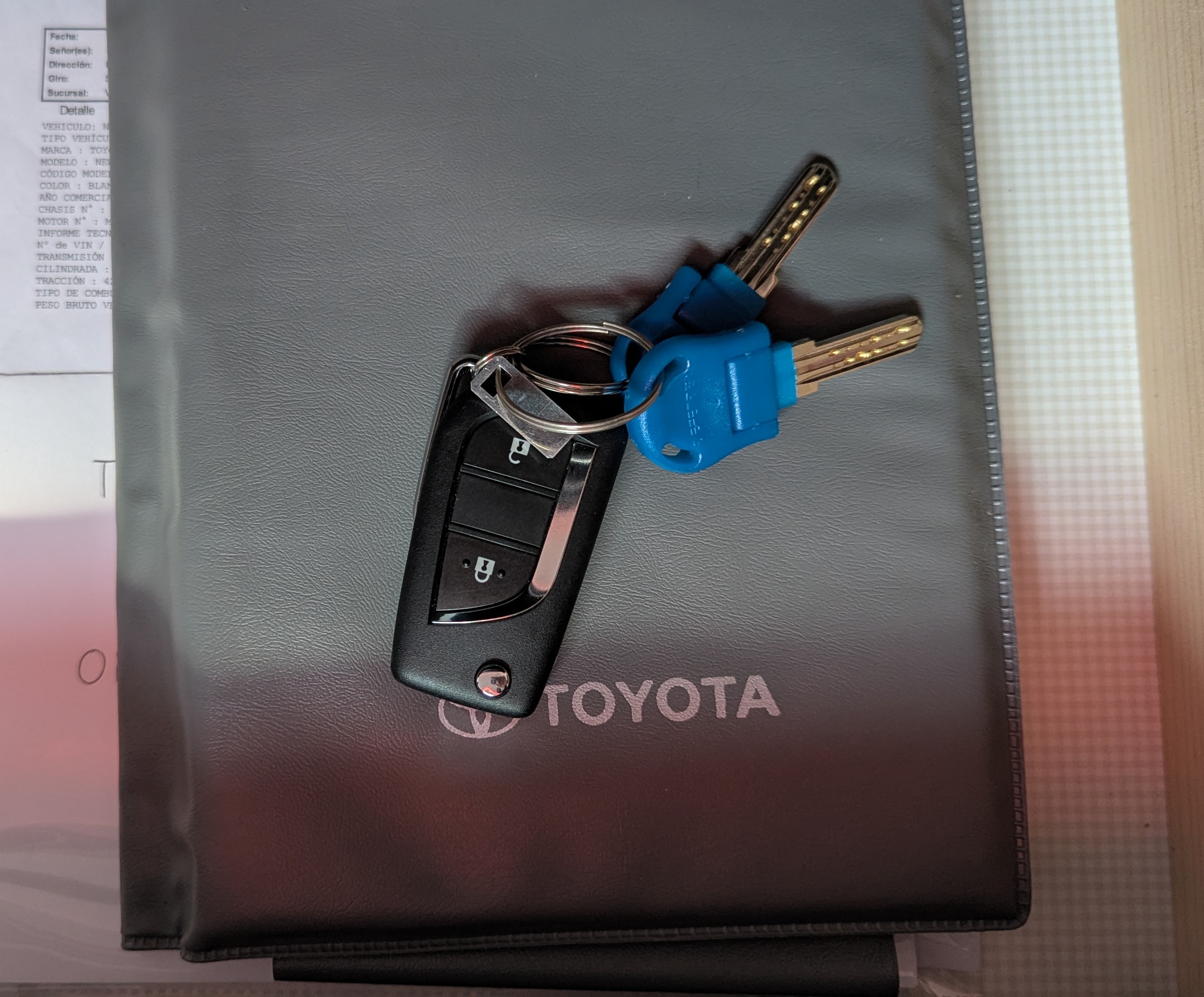
In the lounge inside the right drawer under the TV there's Toyota manual and backup keys (Fig. 1):
- 1 spare key to start and drive Toyota
-
2 blue dimple keys for immobilizer/kill-switch lock. You don't need to have them with you on daily basis, but take one blue key if you're taking Toyota to a mechanic/maintenance. This blue key is needed:
- if the electronic immobilizer fails (e.g. the car doesn't recognize the remote, the battery in the remote is dead)
- after a battery replacement (the system can re-lock mechanically anfter the bar battery is disconnected)
- if a technician needs to disable the system (for servicing the electrical system or starter)
- if the car enters panic-lock mode (the system thinks the car was tampered with)
Refueling the car
The car can be refueled from:
- Paranal gas station (paid by CAMK) → check how here
- any gas station in Antofagasta (you pay for it from your per diems)
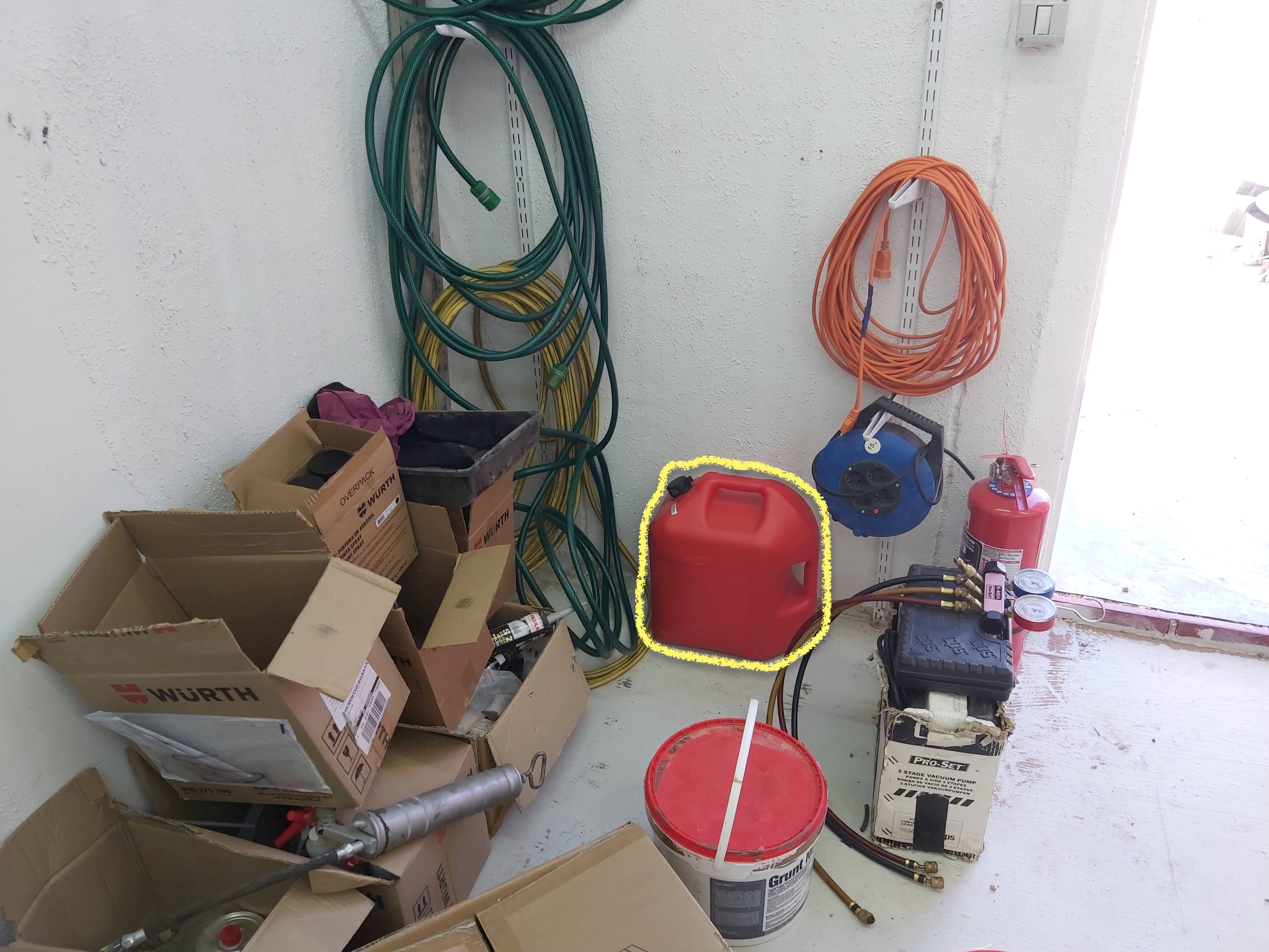
- from the 20-liter canister located in the external storage building (a.k.a. workshop, old BESO room)
Cleaning the car
- In the workshop you will find a Kärcher cleaning device and a water hose. Assemble it and connect to the water outside.
- Turn on the water, then turn on the Kärcher. The order matters, because if you turn the Kärcher before the water, its engine will burn.
- Use Kärcher to rinse the car from dust and sand from the car.
- Use soft microfibra cloth with dish soap to clean grease and stains.
- Use Kärcher again to clean the car from the dishsoap.
- Turn off Kärcher, turn off the water, and then press the Kärcher handle to let the residual water out of the Kärcher.
- Vaccum the inside of the car.
Basic traffic regulations in Chile
- The speed limit in towns is 60 km/h and outside towns 100, highway: 120 km/h.
- Inside and outside the cities you have to drive with daytime running lights ON (pol. światła do jazdy dziennej).
- Right turns are prohibited at red lights unless otherwise posted.
- There is no such road sign as "Priority Road" – only "Give Way" sign. At intersections without traffic lights, drivers must give way to vehicles on the right.
- PARE = STOP
- Seat belts are mandatory for all occupants of the vehicle.
- While driving, smoking is not permitted.
- While driving, using a mobile phone without a hands-free system is not permitted.
- While driving, don't use headphones.
- Tolerance is 5 km/h, above that you might be fined.
- You can be fined for not having the international driving license (or Chilean driving license). This is your responsibility to pay the ticket.
- You can be fined 60.000-90.000 pesos (60-90 euros) if you don't drive with with daytime running lights ON.
Note
In order to secure the payment for the ticket, carabineros take your driving license and give you a document that you have to carry to the police station to have your license back (choose Antofagasta police station). In the police station, you fill in the document describing the circumstances of your speeding and you are put in line to the judge who will decide on the value of your fine. Can be as high as 80 000 peso. This whole procedure can take up to a few days or a week and is troublesome, so simply just drive below the limit.
Contacts
- Miguell Murphy: +56 9 4241 2247 (WhatsApp)
- carabineros: 133
- carabineros (II Zona Antofagasta): 2755000
- oca-operations on Slack and/or WhatsApp group
Situations on the road
Stopped by the police ("carabineros")
Default behavior (when not ordered otherwise by the police officer): Stop the car in a safe manner, do not leave the car (unless ordered by a police officer), put your hands on the steering wheel and wait for further instructions. The officer can ask you to turn off the engine and light the hazard warning lights (emergency lights, orange blinkers). Be humble, say you don't speak Spanish ("no hablo español").
Stopped by a civilian on the road
If someone (civilian) tries to stop you on the road, it is advised not to stop and continue driving, especially during the night. If the person seemed in distress, the best solution is to inform ESO staff (security), try to contact oca-operations on WhatsApp group or directly carabineros.
Accident witness
If you are a witness of a serious accident on the road, and there are no other people to help, stop your car safely and turn on warning lights. Your safety is the absolute priority! Try to safely stop other cars. If there is nobody for help, do not leave your car yet. First try to recognize the situation. What type and how many vehicles participated? Are there any victims? Where are you (how many kilometers from any characteristic point?).
Try to contact oca-operations or carabineros (phone number 133). Use the following phrase, replace exemplary information with the relevant one. Say it calmly and repeat at least three times:
Soy del Observatorio Cerro Murphy, cerca de Cerro Armazones y Paranal, no hablo español.
(I'm from Cerro Murphy observatory, near the Armazones and Paranal mountains, I don’t speak Spanish)
Hubo un accidente en la Ruta 5, a un kilómetro detrás de La Negra, en dirección a Taltal.
(There was an accident on the Ruta 5 road, 1 kilometer behind La Negra, to Taltal’s direction)
Se trata de un automóvil y un camión. Hay heridos.
(A car and a truck are involved. There are injured people)
If you wish to proceed with further help, remember that your safety is the absolute priority. If you have to leave your car, wear a yellow safety jacket, cover/block the accident site with your car on the approaching line, and use a warning triangle.
Accident Involvement
If you participated in the accident and you are able to reach for any help:
1. Try to recognize the situation: where are you (how many kilometers from any characteristic point?) – your smartphone with GPS should help you with this
2. If the accident was serious (someone got seriously injured), contact carabineros (133), Miguel Murphy, *oca-operations*, or ESO staff.
3. If there are no injured, contact Miguel Murphy, and inform him: what happened, when did this happen, how many people were involved, the car's condition.
Technical Problems
Radiator Failure
In case the temperature of the oil is too high, and/or there is steam coming out from the engine, there is a problem with the cooling system. In this case, safely stop the car and turn off the engine. Contact oca-operations on WhatsApp and Miguel Murphy. While there are multiple possibilities for failure, the direct consequence is the lack of cooling liquid. If no other option is reasonable, you can try to continue the trip to safety. Wait 15 minutes, then open the cooling liquid tank. Be very careful, steam from the tank can still be very hot - do it slowly maintaining your face distance. If you can confirm the lack of the cooling liquid, and possible leakage is not too big, you can try to reach the destination.
If you have pure water, slowly put the water into the cooling tank. Start the engine, and drive to the destination, controlling the engine temperature. Try not to stop if it's not necessary, and drive calmly. If the temperature goes high again, stop the car, turn off the engine and wait until the temperature drops. You can repeat the procedure.
Flat tire
Exchange the wheel. Safely stop the car, put a yellow safety jacket on and turn on safety blinkers. You have to prepare a wheel jack, tools, and spare wheel. First loose the screws on the flat tire. Then install the car jack and raise the car until the tire is 5-10 cm above the ground. Unscrew the wheel and take it off the mounting. Put the spare wheel on the mount, and lightly tighten the screws. Lower the car, and deinstall the car jack. Tighten the wheel screws firmly. Collect the stuff, and go to the destination. The spare wheel has lower speed limits – don't exceed 80 km/h!
In order to repair the flat tire, go to Neumáticos Veragua in Antofagasta. They will repair your flat tire, change the spare one to a regular one, check tire pressure, and set it to your desired pressure (30-31 psi). The owner speaks a little English :).
Battery died
If you can't start the engine, there is a chance that the accumulator is drained. You can either use a rectificator in the station to charge the accumulator, or try to start the car with another vehicle if available. Prepare charging cables, and both cars. Both engines should be off. Maintain the order:
- Connect Red cable to the red positive (+) battery clamp on the good vehicle.
- Make sure not to touch anything with the other end of the charging cable.
- Connect the other end of the charging cable to the red positive (+) battery clamp of Captiva.
- Connect Black cable to the negative (-) battery clamp on the good vehicle.
- Connect the other end of the black charging cable to any metal element in the engine of Captiva.
- Try to start the Captiva engine. Do not try more than 3 times.
- If the engine started, disconnect cables in the opposite order.
Tip
Positive (+) stays connected the longest. First to connect, last to disconnect.
The accumulator has to charge, so don't stop the engine for ~1h.
Fluid levels
For cooling fluid, brake fluid and power steering fluid, observe the level in semi-transparent reservoirs, all of them have the min and max marks. For the windshield washer fluid, just check if the sprayers work.
CHECKLIST
Before the drive (C1)
- Documents:
- national driving license
- international driving license
- passport
- revision técnica
- seguro obligatorio
- permiso de circulación
- Level of engine oil
- Lights
- Tire pressure
- Fluids: cooling fluid, brake fluid, power steering fluid, windshield washer fluid
- OCA-phone: google maps location switched on
- Message oca-operations on WhatsApp
During the drive (C2)
- Speed limits: 60 km/h (city), 100 km/h (outside city), 120 km/h (highway)
- Daytime running lights ON
- Fasten your seatbelt!
- If stopped by carabineros: stop the car in a safe manner, do not leave the car, put your hands on the steering wheel.
- Accident witness or involvement: where are you (reference point), call carabineros: 133
- If driving on a spare wheel – don't exceed 80 km/h!
After the drive (C3)
- Message oca-operations on WhatsApp
- Park the car on flat ground or on the slope with the car front facing down